



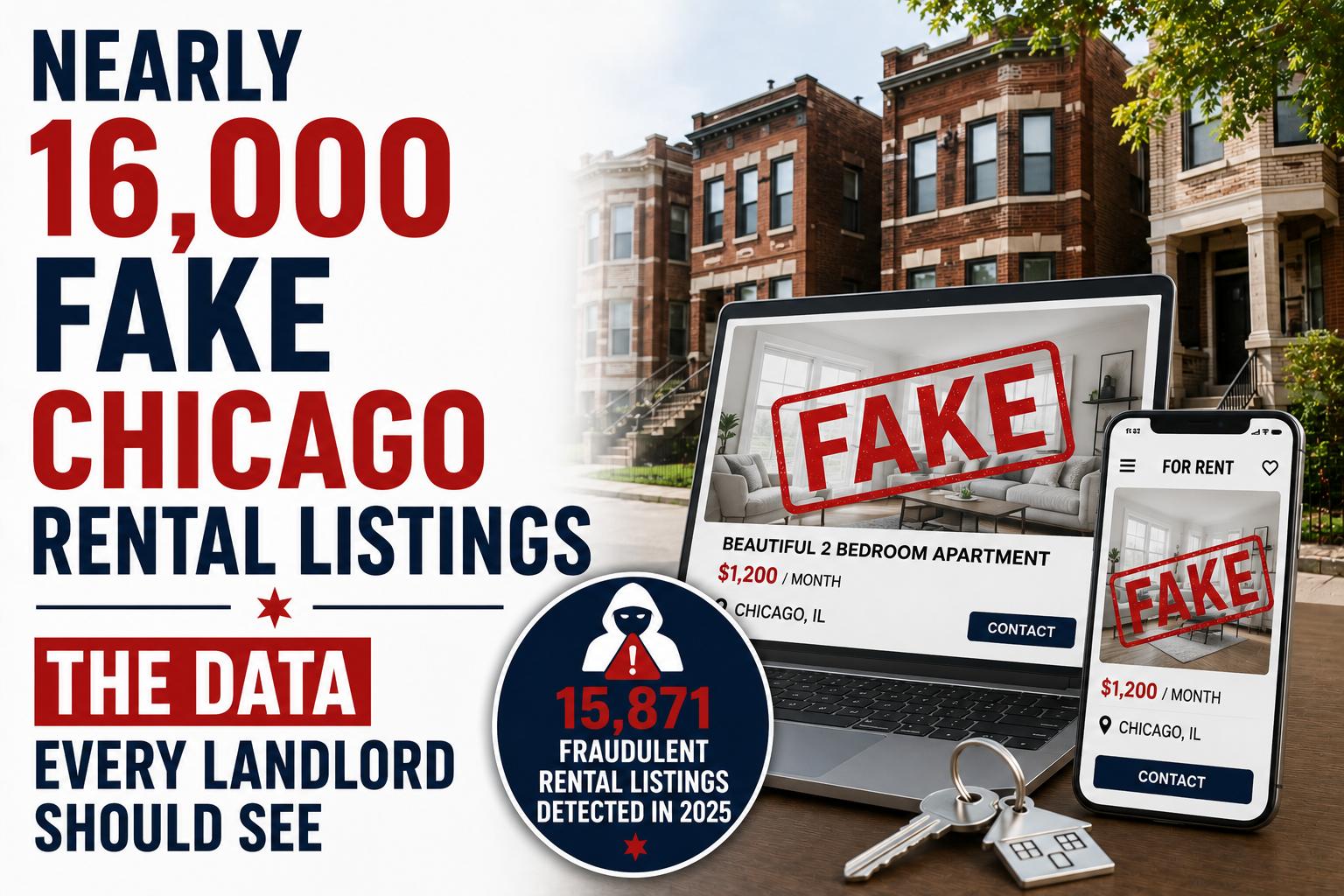
Whether it’s the property management stories the GC Realty & Development team shares here or the conversations on the Straight Up Chicago Investor Podcast, rental fraud has been one of the loudest topics for Chicago landlords in recent years. It’s a real problem, and it’s getting worse. Property Shield just put real numbers on what property managers across the metro have been seeing in the field.
15,871 fraudulent rental listings were detected across the Chicago metro area in 2025 alone. That’s not a typo. Nearly sixteen thousand fake listings designed to scam unsuspecting renters, damage property reputations, and create headaches for the owners who had no idea their property was being used as bait.
These aren’t hitting one type of investor. Institutional investors, property managers, and everyday landlords marketing one or two units are all targets. Every single owner in the Chicago metro is a potential target.
Key Takeaways for Chicago Real Estate Investors
Property Shield detected 15,871 fraudulent rental listings across the Chicago metro in 2025 across 14+ listing platforms.
July 2025 was the single worst month on record with 3,990 fraudulent listings, over 25% of the entire year’s fraud activity.
Summer (June through August) accounted for 8,610 detections, 54% of 2025 fraud.
Oak Lawn (60453) led the metro with 2,027 fraudulent listings, 12.8% of all detections in a single ZIP code.
The top four ZIPs (Oak Lawn, Berwyn, Albany Park/Lincoln Square, Oak Forest) accounted for 30.5% of fraud activity across the entire 25-mile radius.
Fraud is geographically spread across Cook, DuPage, and Will counties, not just the City of Chicago, with the far southwest suburbs (including Aurora and Oswego) especially active in the GC Realty portfolio.
Your Legitimate Listings Are Where It Starts
When a property gets listed on Facebook Marketplace, Zillow, Apartments.com, or anywhere else, the owner is putting information out there for scammers to work with. They scrape photos, copy descriptions, and repost the listing at a lower price on another platform to collect deposits from unsuspecting tenants.
Craigslist deserves a special warning. The honest advice: stay away from it entirely. It’s been a playground for rental scammers for years, and the risk far outweighs whatever exposure an owner thinks they’re getting. The Property Shield data backs this up; their detection engine monitors 14+ listing platforms across the Chicago metro and fraudulent activity is showing up across all of them.
The reality is that every platform used to market a vacancy is also a platform a scammer can use to steal that listing. That doesn’t mean stop marketing. It means staying aware and having a plan in place.
The Summer Fraud Surge
For Chicagoland investors, summer is already peak leasing season. It’s also peak season for scammers.
Period | Fraudulent Listings | Share of 2025 Fraud |
July 2025 (single worst month) | 3,990 | Over 25% |
June – August combined (summer) | 8,610 | 54% |
January 2025 | 482 | (Quiet month) |
March 2025 (year low) | 324 | (Year low) |
The pattern is crystal clear. Fraud ramps up significantly starting in May, explodes through the summer, and doesn’t fully taper off until November. Scammers know exactly when rental demand is highest and tenants are most desperate to lock down a lease.
Where Chicago Metro Fraud Concentrates
Not every area of the metro is equally impacted. The 2025 data shows that certain suburbs and neighborhoods are disproportionately targeted by scammers.
Rank | ZIP Code / Area | Fraudulent Listings | Share of Metro Fraud |
1 | Oak Lawn (60453) | 2,027 | 12.8% |
2 | Berwyn (60402) | 986 | n/a |
3 | Albany Park / Lincoln Square (60625) | 918 | n/a |
4 | Oak Forest (60452) | 898 | n/a |
Oak Lawn’s 12.8% concentration in a single ZIP code is a staggering figure. Between Oak Lawn, Berwyn, the Albany Park and Lincoln Square corridor, and Oak Forest, those top four ZIPs alone accounted for 30.5% of all fraud activity across the entire 25-mile metro radius.
The geographic spread matters too. This isn’t just a City of Chicago problem. Suburbs across Cook County, DuPage County, and Will County are all getting hit. Scammers are targeting areas where rental demand is strong and where tenants may be less skeptical of online listings than they are downtown.
In the GC Realty portfolio specifically, the team saw the most issues in the far southwest suburbs (areas like Aurora and Oswego). Those aren’t the ZIP codes topping the Property Shield list, but that’s the point. Fraud is everywhere across the metro, and every submarket has its own version of this problem.
Where to Go Deeper on Chicago Rental Fraud
Rental listing fraud is one arm of a larger landlord fraud problem that includes stolen-identity tenant applications, squatter setups, and deed fraud. GC Realty has published a full library of resources that pair with this 2025 data analysis:
• How to Spot Red Flags for Rental Scams in Chicago is the landlord-side field guide to recognizing stolen listings and protecting your marketing.
• The Rental Scam Chicago Housing Providers Must Be Prepared For covers the tenant-application side of fraud, including the Stolen Identity Scam Applicant (SISA) scheme.
• Combat Squatter and Deed Fraud Scams covers what happens when a fraudulent listing leads to a squatter situation, including the legal separation between squatters and non-paying tenants.
Investors who want GC Realty & Development actively monitoring for fraud across their Chicagoland portfolio can start with a free rental analysis from the team.
Why This Hits Property Owners Harder Than Most Expect
Here’s what a lot of investors miss: when a scammer posts a fraudulent listing using a property’s address, photos, or details, the fallout lands on the owner. Prospective tenants show up to the property expecting to move in. They’ve already wired deposits to someone who doesn’t own the unit. They’re angry, confused, and sometimes they take it out on the property itself.
In the worst cases, an owner may not even find out until after someone has already moved in. These scammers have become sophisticated enough to hire a locksmith to change the locks and hand over keys like they own the place. At that point it’s not just a fraud problem. It’s a squatter problem, and anyone who’s dealt with the eviction process in Cook County knows how ugly and expensive that can get.
Even when an owner is never directly confronted, a fraudulent listing can undermine legitimate marketing efforts. When renters see the same property listed at wildly different price points across multiple platforms, it creates distrust. The real listing starts looking like the fake one.
How the Scam Playbook Actually Works
The playbook is relatively simple, which is part of what makes it so effective.
Scammers scrape legitimate rental listings from sites like Zillow, Apartments.com, and Craigslist. They copy the photos, rewrite the descriptions slightly, and repost the listing at a lower price point on a different platform. Sometimes they’ll even create fake property management company websites to appear legitimate.
They collect application fees, security deposits, and sometimes first month’s rent from multiple victims before disappearing. By the time the real property owner or a legitimate property manager gets involved, the scammer has moved on to the next listing and the next set of victims.
What Chicago Investors Can Actually Do
For Self-Managing Landlords
Regularly search for property addresses across major listing sites. Set up Google Alerts for every property address in the portfolio so any new listing gets flagged automatically. If a fraudulent listing turns up, report it to the platform immediately and file reports with the FTC and local law enforcement.
For Owners Working With a Property Manager
Make sure the management company is actively monitoring for fraudulent listings. Ask exactly what their process is. If the answer is vague, that’s a signal.
For Tenants Looking at Listings
Always verify the identity of the person showing the property. Never wire money or send funds via apps like Zelle or Venmo for deposits. If a deal looks too good to be true (especially a below-market rent on a nice unit) it almost certainly is.
Tools like Property Shield exist specifically to monitor and detect fraudulent listings in real time, and that layer of intelligence is becoming less of a luxury and more of a necessity for serious investors and management companies operating in the Chicago market.
Frequently Asked Questions About Chicago Rental Listing Fraud
How many fraudulent rental listings hit Chicago in 2025?
Property Shield detected 15,871 fraudulent rental listings across the Chicago metro area in 2025, monitoring 14+ listing platforms across the region.
What month had the most rental fraud in Chicago?
July 2025, with 3,990 fraudulent listings detected, over 25% of the year’s total fraud activity in a single month.
Why does fraud spike so much in summer?
Summer is peak leasing season in Chicago. Scammers follow demand. When more tenants are actively looking and more pressure exists to lock down a lease before move-in dates, scammers have more potential victims to work with. June through August combined produced 8,610 fraud detections, 54% of the entire year’s activity.
Which Chicago-area ZIP code had the most rental fraud?
Oak Lawn (60453) led the metro with 2,027 fraudulent listings, accounting for 12.8% of all detections. Berwyn (60402) was second with 986, followed by Chicago’s 60625 (Albany Park / Lincoln Square) at 918 and Oak Forest (60452) at 898.
Is rental fraud only a Chicago problem?
No. The 2025 data shows fraud concentrated across Cook County, DuPage County, and Will County. Every suburban submarket has its own version of the problem. GC Realty saw the most issues in the far southwest suburbs, including Aurora and Oswego, which didn’t even crack the top ZIP code list.
What should a landlord do if their property gets listed fraudulently?
Report the fraudulent listing to the platform it’s on, file reports with the FTC and local law enforcement, and document everything for future reference. For self-managers, set up Google Alerts on every property address so future fraudulent listings get flagged the moment they go live.
Can a scammer actually get a tenant into the property?
Yes, and this is the worst-case scenario. Sophisticated scammers will hire a locksmith to change the locks, hand over keys, and get a victim moved in before the real owner knows anything happened. That turns a fraud case into a squatter case, which in Cook County means an expensive eviction process on someone who was also a victim of the original scam.
Don’t Wait for Fraud to Find Your Property
The 2025 Property Shield data confirms what Chicago property management operators have been seeing firsthand. Rental fraud is accelerating, it’s concentrated in specific areas, and it peaks exactly when the rental market is hottest. With nearly 16,000 fraudulent listings detected in a single year across the metro, this isn’t a problem any Chicago investor can afford to sit back and hope doesn’t hit their property.
Investors who want GC Realty & Development monitoring for fraudulent listings, handling showing verification, and running the screening process that catches identity fraud before a lease gets signed can call the office at 630-587-7400 or start with a free rental analysis to see what specific protection steps apply to a particular property.