



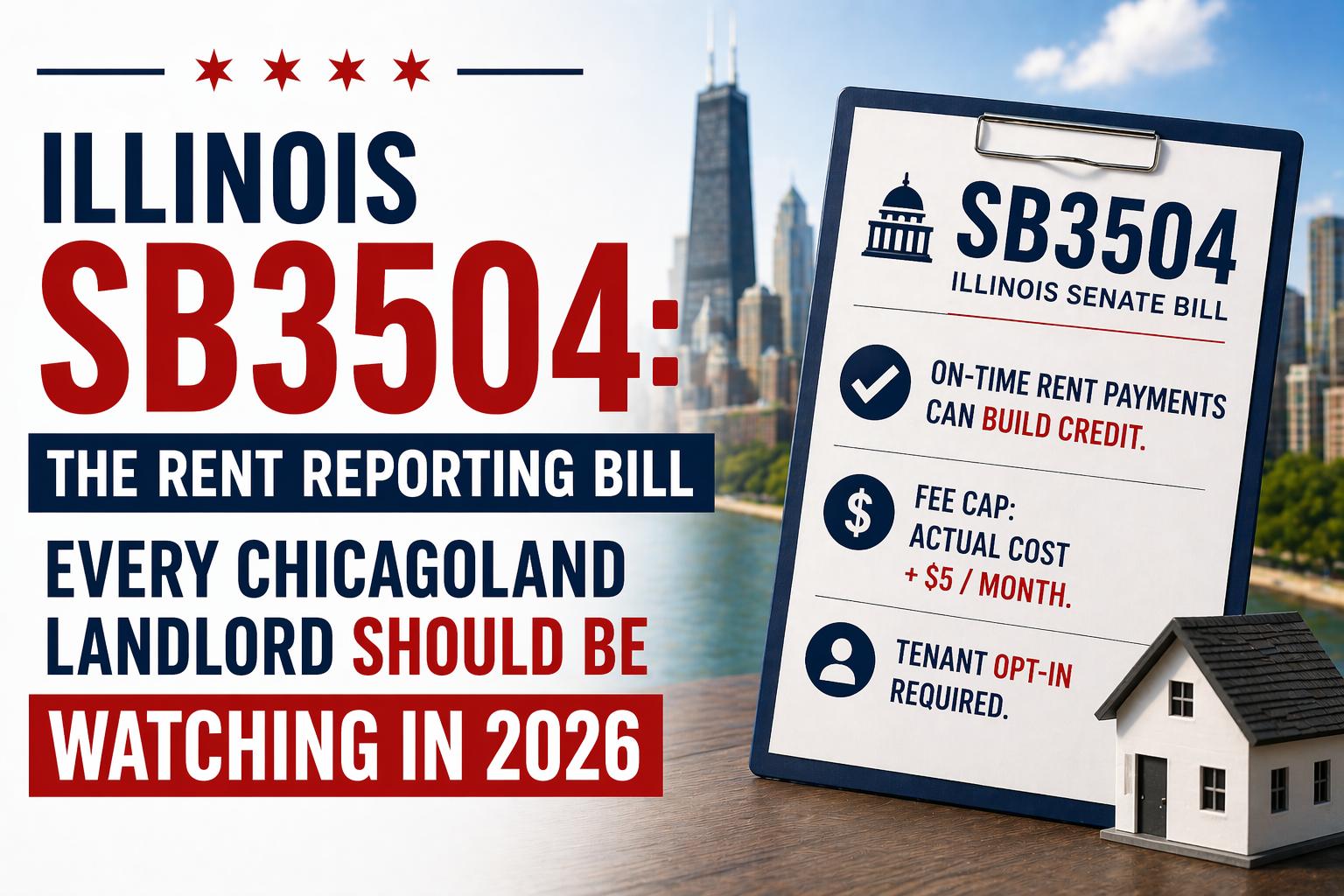
For any property manager paying attention to the Illinois legislative pipeline, most bills come and go without much practical impact on day-to-day operations. SB3504 is different. Introduced in the Illinois Senate in February 2026, the bill would amend the Illinois Landlord and Tenant Act to require qualifying landlords to offer tenants the option to have their on-time rent payments reported to a nationwide consumer reporting agency.
That sounds technical, but the implications are real: changes to the landlord-tenant relationship, tenant credit access, and what it means to be a professional property manager in Illinois. Here’s what the bill actually requires, who it hits, and how Chicagoland landlords should be thinking about it right now.
Key Takeaways for Chicago Real Estate Investors
SB3504 would require qualifying Illinois landlords to offer tenants the option to have on-time rent payments reported to a nationwide consumer reporting agency.
Only positive, on-time payments can be reported. Late or missed payments are NOT captured under this bill.
A fee is allowed, capped at actual cost plus $5 per month; whether the tenant pays that fee cannot be reported to a credit bureau.
Exemption for solo owners with one building of 15 or fewer units held in a personal name. Multi-building owners using corporate entities are covered regardless of unit count per building.
California (AB 2747, 2024) and Missouri are moving in the same direction. Rent reporting is shifting from voluntary to regulatory expectation.
The bill is still in introduced status. The 104th General Assembly session runs through May 2026, which means movement is possible before session close.
What SB3504 Actually Requires
The core of the bill is simple. If you’re a qualifying Illinois landlord, you must offer tenants the option to have their rent payment history reported to at least one nationwide consumer reporting agency. The emphasis is on timely, complete payments. This is positive reporting only, meaning only on-time payments get captured and shared.
Before anything gets reported, the landlord must provide written notice of the offer and obtain written authorization from the tenant choosing to participate. The bill specifies what that notice must contain, so this is not an informal handshake situation. It’s a documented opt-in process, with the tenant in control of the decision.
Landlords can charge a fee for the service, but it’s capped at the actual cost to provide the reporting plus five dollars per month. One important carve-out: whether the tenant pays that fee or not cannot itself be reported to a credit agency. The fee is for the service; it’s not a lever for enforcement.
Who Does SB3504 Actually Affect?
This is where the details matter for smaller Chicagoland operators. The bill exempts landlords of residential buildings with 15 or fewer dwelling units, but only under a specific condition. If that landlord owns just one building, the exemption holds. But if the landlord owns more than one residential rental building, regardless of unit count in each one, AND they’re structured as a corporation, an LLC with at least one corporate member, or a real estate investment trust, the exemption does not apply.
In plain terms: a solo owner with one small building is likely off the hook. A professional landlord with multiple properties held under a corporate entity is in scope regardless of how small each individual building is.
Landlord Profile | Covered by SB3504? |
Solo owner, one property, held in personal name (1-15 units) | Exempt |
Solo owner, one building, held under personal name (15 or fewer units) | Exempt |
Multiple buildings owned under corporation, LLC with corporate member, or REIT (any unit count) | Covered |
Large multifamily operator with 16+ units in a single building | Covered |
What SB3504 Means for Chicago Tenants
For tenants, SB3504 creates a real opportunity to build credit through a major monthly expense that has historically been invisible to the credit bureaus.
Tenants have the right to opt in to having on-time rent payments reported to at least one major credit bureau.
Written notice from the landlord must arrive before anything is reported.
Tenants must provide written authorization before any data is shared.
Any fee charged by the landlord cannot exceed actual cost plus five dollars per month.
Whether the tenant pays that fee cannot itself be reported to a credit agency.
Positive-only reporting, so late or missed payments are not part of what gets reported under this bill.
What SB3504 Means for Chicago Landlords
For qualifying landlords, SB3504 is an operational lift that needs planning before (not after) the bill passes.
Documented Notice and Authorization Workflow
A written notice process and authorization tracking system have to be in place before any tenant data gets reported. The notice content is specified by the bill itself, so the current lease paperwork likely isn’t compliant as written.
A Relationship With a Compliant Consumer Reporting Agency
The bill requires reporting to at least one nationwide consumer reporting agency. Chicago-area landlords in scope will need to establish that vendor relationship before going live with the offer.
A Fee Structure Within the Cap
If a qualifying Illinois landlord chooses to charge for the service, the fee must stay within the cap of actual cost plus five dollars per month. Pricing above that violates the statute.
Property Management Software That Tracks the Workflow
Any portfolio that doesn’t currently support rent reporting workflows will need a software upgrade. Tracking the opt-in status of every tenant and ensuring that only authorized data flows to the bureau is the minimum system requirement.
Staff Trained on the Authorization Requirements
The biggest exposure point on SB3504 will be inadvertent reporting for tenants who never authorized it. That’s the kind of compliance failure that produces tenant complaints and potentially legal exposure, which is why staff training matters more than the software itself.
The Flip Side: Offer It Early as a Competitive Advantage
There’s also an opportunity. Offering rent reporting proactively, before any mandate takes effect, positions a Chicago portfolio as a tenant-friendly choice in a competitive rental market. Tenants who are actively building credit have a tangible reason to pay on time and a reason to stay.
Where to Go Deeper on Illinois Landlord Legislation
SB3504 isn’t happening in isolation. Illinois has been layering in new landlord-tenant legislation annually, and any Chicagoland investor serious about staying ahead of it should work through these verified GC Realty resources:
• How the 2025 Illinois Tenant Credit Report Law Impacts Landlords covers the reusable credit report framework that took effect in 2025, a natural companion to SB3504’s rent-reporting angle.
• 2026 Illinois Landlord Law Changes walks through the laws that took effect January 1, 2026, giving context for the broader direction of state policy.
• Chicago’s Fair Notice Ordinance covers the existing notice requirements landlords must already handle, which gives a useful framework for the new notice process SB3504 would add.
Investors who want GC Realty & Development handling compliance planning and tenant communication across a Chicagoland portfolio can start with a free rental analysis from the team.
Why Rent Reporting Matters Beyond the Compliance Question
Unlike homeowners who build credit with every mortgage payment, renters have historically not had their rental payments factored into their credit scores. That asymmetry is significant. A tenant paying $1,200 a month on time for five years gets nothing on their credit report for it, while a homeowner making the same payment builds five years of positive payment history.
The research supports changing that. A study referenced by the National Low Income Housing Coalition found that rent reporting can significantly increase credit visibility, helping tenants go from having no credit score to having one, and can raise existing scores to near-prime levels above 601 for those with low or no prior credit history. According to a TransUnion survey, 13 percent of renters saw their payments reported to credit bureaus in 2025, up from 11 percent in 2024. That growth is happening organically even without a mandate.
The landlord side of the math is favorable too. Data suggests landlords who offer rent reporting see meaningful reductions in payment delinquencies, while tenants have reported credit score increases of more than 40 points in a matter of months. A tenant who’s building credit through rent payments has a tangible reason to pay on time and a reason to stay. That’s a retention and cash flow story, not just a feel-good one.
The Bigger Picture: Rent Reporting Is Moving From Voluntary to Required
Illinois is not the first state to push in this direction. California passed AB 2747 in 2024, which requires property managers of buildings with 16 or more units to offer positive rent payment reporting to credit bureaus. Missouri has introduced similar legislation. The direction is clear across the country: rent reporting is moving from a voluntary feature some landlords offer to a regulatory expectation.
Third-party services already operating in this space (including Esusu, RentTrack, and others) integrate with property management platforms and handle reporting to one or more of the three major bureaus. Some of these services are free for tenants when the landlord covers the cost, and the better platforms report to all three major bureaus automatically without requiring extra work from the tenant.
SB3504 is still in introduced status, but the direction of state and federal policy on rent reporting makes this a matter of when, not if, for Illinois. Qualifying landlords should be evaluating their current systems now rather than scrambling after a passage date gets announced.
Frequently Asked Questions About Illinois SB3504
Does SB3504 require landlords to report all tenant rent payments?
No. The bill only requires qualifying landlords to offer tenants the option. Reporting only happens if the tenant provides written authorization. And only on-time payments get reported, never late or missed ones.
Can a Chicago landlord charge tenants for rent reporting under SB3504?
Yes, but the fee is capped at actual cost to provide the reporting plus five dollars per month. Any fee above that cap violates the statute. And whether the tenant pays that fee cannot itself be reported to a credit bureau.
Which Illinois landlords are exempt from SB3504?
Solo owners with one residential building of 15 or fewer dwelling units, held in a personal name, are exempt. The exemption disappears if the landlord owns multiple buildings AND is structured as a corporation, LLC with at least one corporate member, or REIT, regardless of unit count per building.
When would SB3504 take effect if passed?
The bill was introduced in February 2026. The 104th Illinois General Assembly session runs through May 2026, which means there’s runway for movement before session close. The bill could pass, stall, get re-referred to committee, or carry over to the next session.
What happens to late or missed payments under SB3504?
They don’t get reported under this bill. SB3504 is positive-only reporting, meaning only on-time payments can be captured and shared. This is a significant limitation (and protection for tenants) compared to the way mortgage payment data flows to credit bureaus today.
Is rent reporting already happening in Illinois without a mandate?
Yes. Roughly 13 percent of U.S. renters saw their payments reported to credit bureaus in 2025 per a TransUnion survey, up from 11 percent the prior year. Third-party services like Esusu and RentTrack integrate with property management platforms and handle the reporting workflow. SB3504 would formalize and expand what’s already happening voluntarily.
What should Chicago landlords do right now?
Three things. Identify whether the portfolio is in scope (corporate structure + multiple buildings is the common trigger). Evaluate the current property management software for rent-reporting workflow support. And start conversations with consumer reporting agency vendors or third-party platforms before any mandate takes effect. Offering the service proactively also creates a competitive marketing angle.
What Comes Next and How to Stay Informed
As of the time this article was written, SB3504 has been introduced in the Illinois Senate but hasn’t officially passed. The 104th General Assembly session runs through May 2026, which means there’s still runway for the bill to move through committee, get a floor vote, cross over to the House, and reach the Governor’s desk before the session closes. It could also stall, get amended significantly, or get re-referred to Rules and sit until next session.
That uncertainty is exactly why it pays to watch bills like this early rather than scramble after a passage date gets announced. Investors who want to stay ahead of the legislation affecting their Chicagoland investment property can subscribe to the GC Realty blog and the Straight Up Chicago Investor Podcast, which cover this kind of legislative pipeline consistently.
Stay Ahead of the Legislative Pipeline
Illinois landlord legislation isn’t slowing down. SB3504 is one more signal that Chicago-area property owners operating under corporate entities need to treat compliance as infrastructure, not reaction. The operators who build the systems now will absorb the next round of regulation quietly. The ones who wait will be scrambling.
Investors who want GC Realty & Development running the compliance planning, tenant communication, and operational infrastructure that keeps a Chicagoland portfolio ahead of the legislative pipeline can call the office at 630-587-7400 or start with a free rental analysis to see what a specific property needs to stay compliant.